



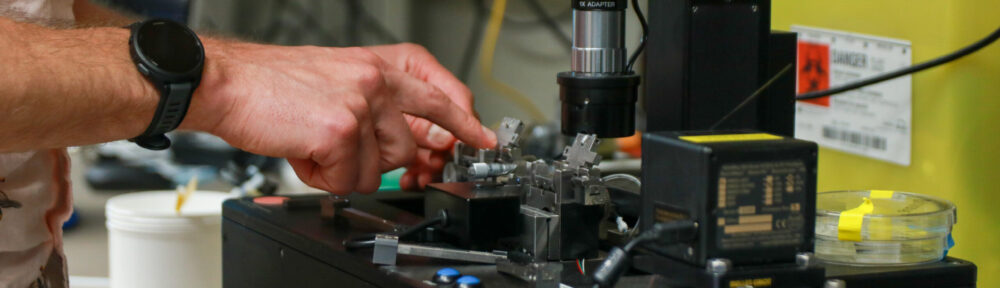
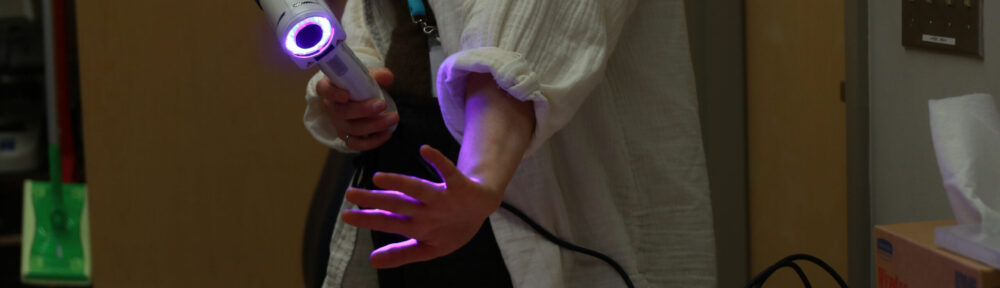
Image-guided techniques for biopsy site selection and tumour boundary delineation have the potential to significantly improve the management of oral cancer. OCT can provide high-resolution 3-dimensional images of tissue in real time to distinguish morphological tissue features associated with neoplastic development.
Optical Coherence Tomography (OCT)
Our OCT catheter and swept-source instrumentation are capable of wide-field in vivo imaging in the oral cavity. We use a hand-held side-looking fiber-optic rotary pullback catheter that images very long tissue volumes — 90 mm in the pullback direction, ~2 mm into the tissue, and ~2.5mm transverse to the pullback direction — providing a 90-by-2.5 mm enface footprint on the tissue surface. This instrument provides a wide-field view of features such as epithelial thickness and continuity of the basement membrane that may be useful in clinic for chair-side management of oral lesions.
Normal versus Abnormal Oral Mucosa
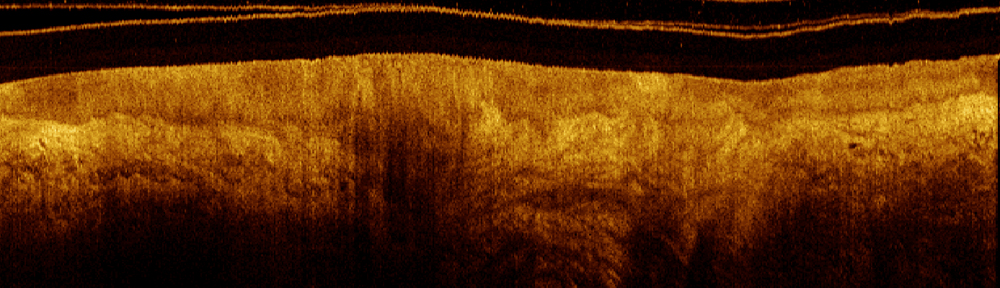
The OCT sections below show normal (top) and abnormal (bottom) oral mucosa. The images are very wide (33 mm of pullback) and narrow (1.2 mm of tissue depth) and have been compressed in the horizontal dimension to facilitate display (28:1 aspect). The normal section shows the epithelium and submucosa as uniform intensity stratifications.
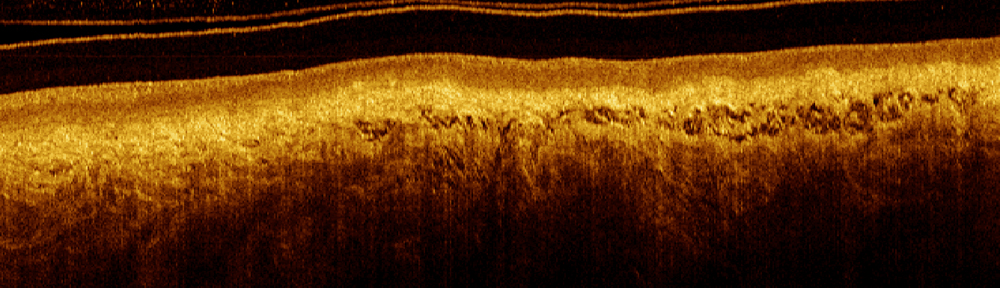
The abnormal section shows thickening of the epithelium, loss of visibility of the basement membrane, and irregular intensity stratification.
Continue with Cervical Cancer.